


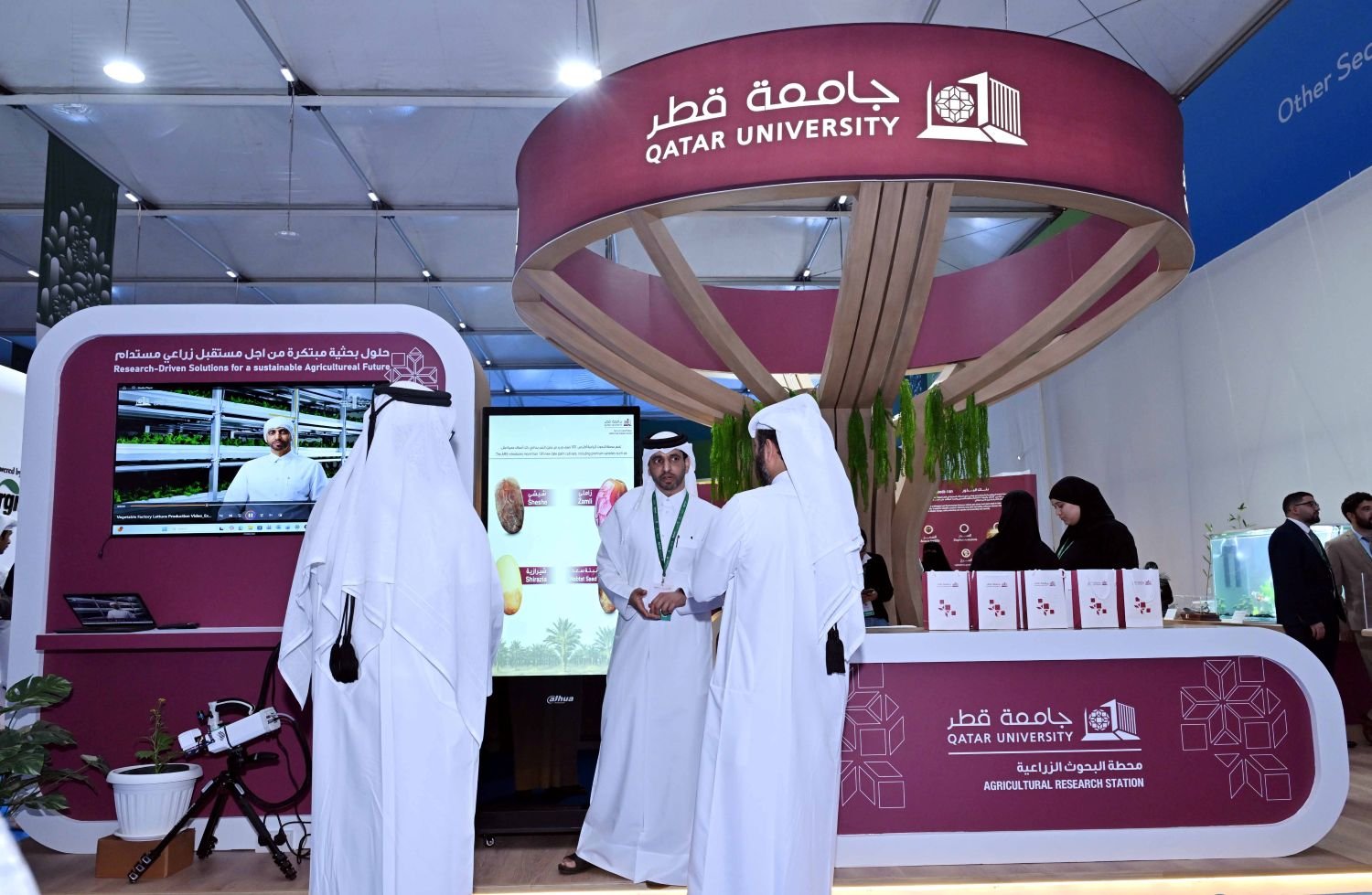
Doha: Qatar University (QU), represented by its Agricultural Research Station (ARS) and Center for Sustainable Development (CSD), is participating in the 13th edition of the Qatar International Agricultural Exhibition (AgriteQ 2026), taking place from 12-16 February 2026 at Katara Cultural Village.
The Center for Sustainable Development, under the College of Arts and Sciences, will showcase research that supports sustainable agriculture and food security. A key highlight is its algae applications program, which converts locally sourced algae into high-protein feed for fish and livestock, reducing reliance on imports. The program also explores algae as bio-fertilizer and as a source for human nutritional supplements, linking agricultural innovation with public health and sustainability.
The Department of Biological and Environmental Sciences will participate through three educational themes designed to promote environmental awareness and sustainability in Qatar, reflecting the University’s role in connecting research with real environmental challenges. Visitors will explore Qatar’s plant diversity through the University herbarium and seed bank, including medicinal and endangered species, alongside educational materials on conservation. A parallel exhibit highlights desert wildlife and ecological balance, while the final theme focuses on marine conservation through ongoing research on whale sharks, an internationally endangered species that seasonally gathers in Qatari waters.
Through its participation, the Agricultural Research Station is showcasing its latest innovations in arid agriculture, offering visitors an interactive window into cutting-edge research that supports national food security and sustainable agricultural development.
Through immersive visual displays of its orchards, educational models, and rare premium date palm cultivars from its germplasm collection, ARS highlights its leadership in agricultural science. The pavilion also introduces advanced, environmentally friendly post-harvest technologies, including a non-toxic pest control system, alongside live demonstrations of crop physiology tools.
Among the featured innovations is a project focused on the valorization of tomato waste, which introduces environmentally responsible methods to transform agricultural byproducts into value-added materials. The initiative contributes to reducing waste and emissions while supporting sustainable food systems and local agricultural resilience.
QU is also presenting research on hydrogel-based agricultural technology designed to improve soil water retention and reduce freshwater consumption. This solution supports efficient irrigation practices and promotes agricultural sustainability in water-scarce environments, reinforcing efforts to enhance national food security.
In addition, QU is showcasing an integrated circular bioeconomy project that converts agricultural waste into renewable biogas and protein-rich biomass through advanced fermentation processes. The research demonstrates how waste-to-energy and waste-to-protein technologies can operate together to reduce environmental impact while generating high-value resources for food and feed applications.
Director of QU’s Agricultural Research Station, Dr. Mohammed Al-Safran affirmed that the station’s participation in AgriteQ represents a continuation of its national role in supporting the path of sustainable agricultural development in the State of Qatar. He noted that the station is keen to showcase its latest research outputs and practical applications developed specifically to suit arid and semi-arid environments.
He added: “At the Agricultural Research Station, we work through an integrated vision that combines applied scientific research with knowledge transfer to farmers and relevant stakeholders, contributing to enhanced production efficiency, more responsible use of natural resources, and increased self-sufficiency in strategic crops. Our participation in AgriteQ 2026 reaffirms our commitment to supporting national food security, strengthening research partnerships, and presenting innovative solutions that serve the agricultural sector and help build a dynamic, sustainable economy based on knowledge and innovation.”
Director of QU’s Center for Sustainable Development, Professor Sami Sayadi, emphasized that a primary research pillar of the Center is to advance food and water security in Qatar. These efforts align with the university’s research priorities and the Qatar National Vision 2030. Professor Sayadi noted that the CSD prioritizes sustainable food production improvement using recycled organic residues and bioactive compounds sourced from the local environment. Key innovations include microalgae-based fish feed, biofertilizers made from microalgal extracts and Plant Growth-Promoting Rhizobacteria (PGPR) as well as soil enhancers derived from the pyrolysis of crop residues in the framework of circular economy, all designed to bolster national self-sufficiency in various food commodities.
QU’s participation in AgriteQ 2026 reflects its ongoing commitment to translating research into practical solutions that strengthen Qatar’s agricultural ecosystem. By bridging academic research with real-world applications, the University continues to support innovation that advances sustainability, food security, and economic diversification.
Source: QU