


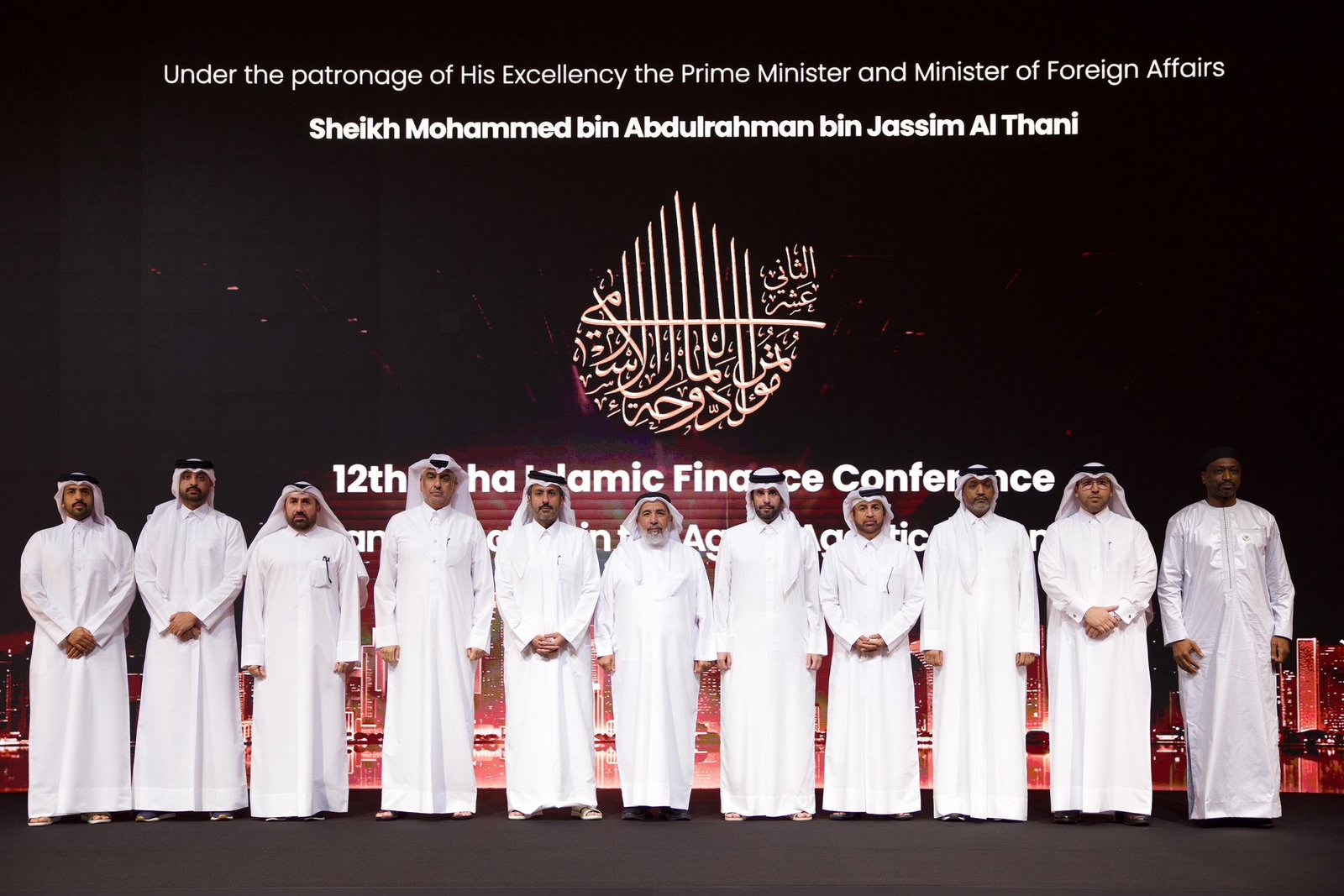
Doha: Under the patronage of HE Prime Minister and Minister of Foreign Affairs Sheikh Mohammed bin Abdulrahman bin Jassim Al-Thani, the 12th Doha Islamic Finance Conference opened in Doha on Tuesday, bringing together government officials, international organizations, financial institutions, academics, and technology experts to examine the future of Islamic finance in an era increasingly shaped by artificial intelligence.
Held under the theme “Islamic Finance in the Age of Agentic Systems,” the conference was inaugurated by HE Minister of Commerce and Industry Sheikh Faisal bin Thani bin Faisal Al-Thani in the presence of HE Minister of Endowments and Islamic Affairs Ghanem bin Shaheen bin Ghanem Al Ghanem.


The conference focuses on the transformative potential of agentic AI systems—advanced technologies capable of autonomous decision-making within legal and Sharia-compliant frameworks—and their impact on Islamic finance, endowments (waqf), zakat management, and sustainable economic development.
Addressing the opening session, HE Chairman of the Board of Directors of Dukhan Bank Sheikh Abdulla bin Fahad bin Jassim Al-Thani highlighted the rapid evolution of smart technologies and their ability to reshape financial services by enhancing efficiency, responsiveness, and innovation. He emphasized that digital transformation remains a cornerstone of Dukhan Bank’s strategy, noting the bank’s strong financial performance throughout 2025 and its recognition with the Best Digital Transformation Initiative award in the Middle East and North Africa.
Director-General of the General Directorate of Endowments at the Ministry of Endowments and Islamic Affairs (Awqaf), Eng. Hassan Abdullah Al Marzouqi, underscored the enduring role of endowments as a pillar of Islamic civilization and modern societal development. He stressed the importance of assessing the legal, regulatory, and Sharia implications of emerging technologies while ensuring that their adoption supports public interest, sustainable development, and the long-term growth of endowment assets.
Hamed Al Saadi, Chief Financial and Tax Officer at Qatar Financial Centre (QFC), said the conference theme reflects the profound transformations underway in the financial sector as a result of AI. While emphasizing the significant opportunities presented by intelligent systems, he noted that effective implementation requires robust governance, transparency, accountability, and careful consideration of the degree of autonomy granted to such technologies.
For his part, Secretary-General of the International Islamic Fiqh Academy (IIFA), Dr. Qutb Mustafa Sano, argued that the key challenge is not whether to accept agentic systems, but how to guide and utilize them in line with the objectives of Islamic Sharia. He said the future relationship between humans and intelligent systems should be based on integration and cooperation, with technology enhancing efficiency and precision while ethical and legal responsibility remains with people.
Chairman of the Higher Organizing Committee of the Doha Islamic Finance Conference, Prof. Dr. Khalid bin Ibrahim Al Sulaiti, said the event comes at a time of unprecedented global economic, technological, and geopolitical change. He noted that agentic systems are increasingly becoming essential tools for analyzing vast data sets and making rapid decisions, making their role in Islamic finance a strategic issue that extends beyond technology to the future architecture of the financial industry.
Al Sulaiti stressed that Islamic finance must not only adapt to these transformations but also contribute to developing a financial model that combines technological innovation with ethical governance and value-based principles.
The conference agenda features four key themes: the application of intelligent systems in Islamic financial institutions, the future of endowments in the era of agentic AI, virtual influencers and Islamic finance, and the role of zakat in development within increasingly automated environments.