

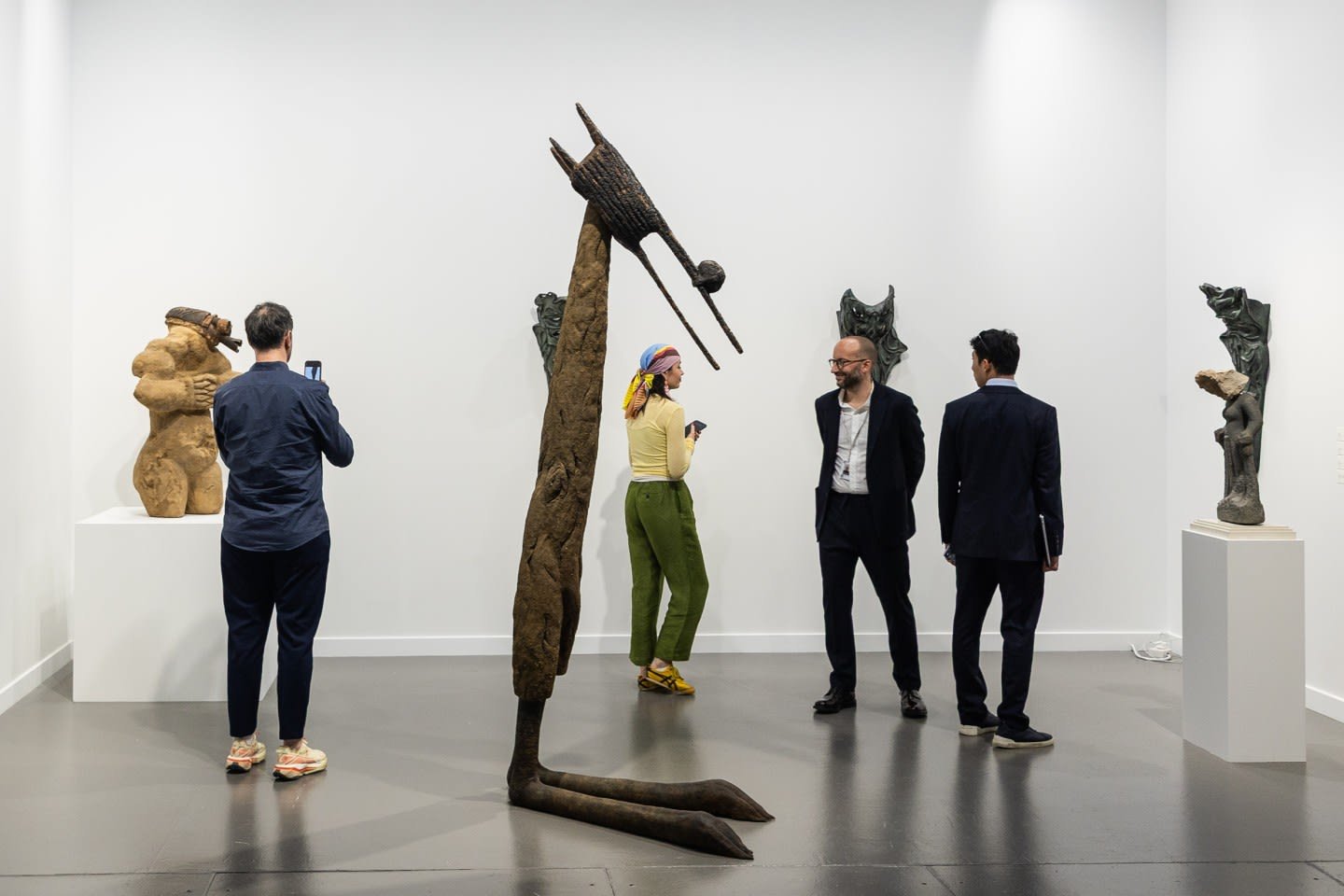
In February 2026, something shifted in the art world. Art Basel touched down in Doha for the very first time, its fifth global fair, and its first ever in the Middle East. It wasn’t just a new location on the map. Spread across M7 and the Doha Design District in the heart of Msheireb Downtown Doha, the fair arrived with a clear intention: to do things differently. Its guiding theme was a single, quietly powerful word, “Becoming.”
Over 17,000 visitors showed up. 87 galleries arrived from 31 countries. And more than half the artists on show came from the Middle East, North Africa, and South Asia, a deliberate, meaningful choice. Leading it all was Egyptian artist Wael Shawky, whose artistic direction threw out the usual booth-and-sales-floor playbook entirely. Instead, each artist got space for a solo presentation with the kind of depth you’d expect from a museum show, not a fair. Critics and collectors took notice. Many called it a genuine reimagining of what a commercial art fair could be.
Sales were quieter than at other Art Basel editions, and that was almost beside the point. What the fair actually set out to do, it did. Doha earned its place as a serious, credible home for contemporary art on the world stage. And beneath the surface, something longer-term was taking root: the early foundations of a real collector culture in the Gulf, built to last well beyond a single opening weekend.
Statistics At-A-Glance
87 Galleries
from 31 Countries
17,000+
Visitors
50%
Artists from MENASA
16
New Exhibitors
85+
Museums & Foundations Represented
5th
Global Fair
| Edition | Inaugural (1st) Edition |
| Dates | Preview: Feb 3–4, 2026 (invitation only) | Public: Feb 5–7, 2026 |
| Venues | M7, Abdullah Bin Thani St & Doha Design District, Al Jeewan St, Msheireb Downtown Doha |
| Curatorial Theme | “Becoming” |
| Artistic Director | Wael Shawky (Egyptian artist; Artistic Director of Fire Station, Doha) |
| Chief Artistic Officer | Vincenzo de Bellis, Art Basel |
| Key Partners | Qatar Sports Investments (QSI); QC+ (commercial arm of Qatar Museums) |
| No. of Galleries | 87 from 31 countries and territories |
| First-Time Exhibitors | 16 galleries participating in Art Basel for the first time |
| Total Visitors | 17,000+ (VIP + public) |
| MENASA Representation | More than 50% of featured artists from MENA and South Asia |
| Museum Attendees | Representatives from 85+ museums and foundations |
Art Basel’s Global Expansion
Art Basel didn’t become the world’s most respected art fair by standing still. Founded in Switzerland in 1970, it has spent the last two decades planting roots in cities where culture and ambition intersect: Miami Beach in 2002, Hong Kong in 2013, and Paris in 2022. Qatar is the fifth stop on that journey, and perhaps the most intentional one yet. For MCH Group, Art Basel’s parent company, this isn’t just expansion, it’s a long-term bet on where the art world is heading.
Behind the scenes, the partnership brought together Qatar Sports Investments and QC+, the commercial arm of Qatar Museums, a pairing that signals both state ambition and serious financial commitment. Art Basel CEO Noah Horowitz was clear about what made this edition different: it wasn’t dropped into a ready-made ecosystem. It was built from scratch, with intention.
Qatar’s Cultural Vision
Art Basel Qatar is the latest expression of Qatar’s National Vision 2030, which includes a sweeping investment in cultural infrastructure. The country already operates five national museums, including the Museum of Islamic Art and the National Museum of Qatar. Three further museums are planned by 2030, including the Art Mill Museum and the Lusail Museum, future homes for works acquired at fairs such as this one.
At the center of Qatar’s cultural story is one person: HE Sheikha Al Mayassa bint Hamad bin Khalifa Al Thani. As chairperson of Qatar Museums, she has spent decades personally shaping what the country collects and why. Her influence was but the fair’s most powerful buyer in the room. On exhibited works, underscoring the state’s role as anchor buyer.
Global Art Market Context
The timing of Art Basel Qatar’s debut was no accident. The global art market had just clawed back some ground, and the 2026 Art Basel and UBS Global Art Market Report recorded a 4% rebound in sales to an estimated USD 59.6 billion in 2025, ending two consecutive years of decline. Art fair sales rose too, hitting their highest share of dealer turnover since 2022. Meanwhile, the Gulf has been moving in its own direction entirely, accelerating its cultural investment. At the same time, other markets hesitated, making it one of the few genuine growth frontiers left for international galleries.
The “Becoming” Theme
One word set the tone for everything: Becoming. It’s a deceptively simple idea, humanity in motion, identity shifting, meaning constantly being made and remade. But as a curatorial lens, it gave the entire fair a coherence that’s genuinely rare in commercial art spaces. Every gallery selection, every presentation, every conversation in the room was quietly shaped by it.
Wael Shawky, a celebrated Egyptian artist, multidisciplinary creator, and the first recipient of Qatar’s new creative visa, brought a vision that went well beyond curation. For him, the fair was never just a place to sell art. It was a platform for culture. He made sure MENASA voices weren’t just represented but centered, and treated education and dialogue as seriously as any transaction on the floor.
Booth-Less, Solo-Presentation Model
Walk into most art fairs and you know exactly what you’re getting: booth after booth, gallery after gallery, works competing for your attention. Art Basel Qatar threw that playbook out entirely. Every gallery brought just one artist, one voice, one world, given the room to breathe. The result felt less like a fair and more like a biennial. Visitors moved through M7 and the Doha Design District the way you’d move through a great museum, slowly, deliberately, letting each presentation settle.
Klaus Biesenbach, director of Berlin’s Neue Nationalgalerie, put it plainly: “There is no going back” to the old booth format. He wasn’t alone. Across the fair, art professionals kept reaching for the same word to describe what they were seeing: institutional. As in: the kind of quality you expect from a great museum, not a commercial fair.
The format did something else, too: it made space for work that actually has something to say. Several galleries brought pieces that addressed the Israel-Palestine conflict directly and unflinchingly, a contrast that didn’t go unnoticed. At recent Art Basel editions, overtly political work has tended to sit at the margins. In Doha, it stood at the center.
Venue & Urban Integration
The fair didn’t stay behind closed doors. Anchored at M7 and the Doha Design District in Msheireb Downtown Doha, it spilled outward, with large-scale installations claiming public squares, performances unfolding in the open air, and works appearing in places you’d stumble across without looking for them. The city became part of the show. And the audience expanded with it, drawing in people who had never set foot in an art fair and probably never planned to.
Notable Presentations & Highlights
| Manal AlDowayan | Unveiled The Awakening of The Recline, three large-scale tapestries exploring women’s visibility within cultural frameworks. Presented by Sabrina Amrani Gallery. |
| Hugo McCloud | Created Pollinated Migration specifically for Art Basel Qatar, using single-use plastic bags to map networks of ecology, commerce, and human movement. Presented by Sean Kelly. |
| Philip Guston | Hauser & Wirth presented an intimate encounter with Guston’s late, psychologically charged paintings, including Conversation (1978) and Sign (1970). |
| Bouthayna Al Muftah | An immersive installation transforming a traditional Qatari thobe into a living archive of oral history and familial memory, an inhabitable space of cultural preservation. |
| Aiza Ahmed | New York-based Pakistani artist presented Footnotes (2026) via Sargent’s Daughters, a site-specific installation inspired by the Wagah-Attari border ceremony, exploring marginalized musicians in nationalist spectacle. |
| Jenny Holzer | SONG (2026) was displayed at the Museum of Islamic Art as a Special Project, extending the fair’s reach beyond its primary venues into Doha’s established cultural institutions. |
| Mustapha Azeroual | Moroccan-French artist’s immersive constellation of works, including The Green Ray #5 (Arabian Sea), presented by Loft Art Gallery in its Art Basel debut. |
Regional gallery debuts included The Third Line (Dubai), Hafez Gallery (Saudi Arabia), Tabari Artspace, and Al Markhiya, reflecting the fair’s commitment to elevating Gulf-based commercial spaces on the global stage. Sixteen galleries participated in the Art Basel fair for the first time.
Sales Moved Differently Here, and That Was the Point
If you were expecting the usual opening-day frenzy, blue-chip works flying off walls, transactions announced before lunch, Art Basel Qatar had other ideas. HH The Amir Sheikh Tamim bin Hamad Al Thani and HE Sheikha Al Mayassa bint Hamad Al Thani came through quietly on the Monday before the VIP preview, moving at their own pace and placing works on hold. Galleries were told decisions would come within 24 hours. In practice, things took a little longer. And somehow, that felt right.
Collectors here don’t perform their purchases. Artnet News noted a strong preference for private room transactions, which Gurr Johns advisor Diane Abela called the Gulf’s “mindful” collecting culture. Qatar Museums was a constant, quiet presence throughout. Guy Bennett, the institution’s director of collections and acquisitions, moved steadily from booth to booth, confirming interests without fanfare.
What Actually Sold
Galleries kept most numbers close to their chest, but a few transactions made it into the open:
- Sargent’s Daughters had a strong showing for Aiza Ahmed, with the largest work going to an unnamed institution, while smaller pieces found homes in the $3,500–$25,000 range.
- According to Artsy, Georg Baselitz’s works led the pack in reported sales.
- Several works were confirmed for Qatar Museums’ contemporary collection, future residents of the Art Mill Museum, set to open in 2030.
- Mid-market works by MENASA artists drew genuine attention from both institutions and private collectors, a quiet but meaningful sign of where the market’s interest is shifting.
The more accessible price points weren’t accidental. Qatari state entities heavily subsidized booth costs and shipping, taking the commercial pressure off galleries. That breathing room changed the atmosphere entirely; conversations could go deeper, relationships could form, and no one felt rushed to close a deal before the next collector walked in.
Building a Collector Base From the Ground Up
The big question hanging over the fair’s future isn’t about quality; that’s been settled. It’s about depth. Can Art Basel Qatar build a private collector base that goes beyond royal patronage and state institutions? The early signs are cautiously promising. Nearly half of the private collectors and patrons in attendance came from the MENASA region, with others traveling from Asia, Africa, Europe, and the Americas. The geographic spread is real. But most industry observers were honest: the collector ecosystem here is still young, still forming, still finding its shape.
The people who know this world best were measured in their expectations and refreshingly honest about it. Philip Hoffman, CEO of The Fine Art Group, put it this way: “Everything needs three years to bed in.” Iwan Wirth of Hauser & Wirth agreed, in his own way: “This year is not important, next year will be important.” Nobody was pretending the debut was a commercial triumph. What it was, dealer after dealer said, was a beginning, a chance to build the kind of trust and relationships that turn a first edition into a lasting institution.
Cultural Programming & Conversations
Alongside the gallery presentations, Art Basel Qatar hosted a robust program of public events reinforcing its identity as a cultural platform rather than purely a commercial fair:
- “Leaders of Change” panel discussion featuring HE Sheikha Al Mayassa, LUMA founder Maja Hoffmann, and Serpentine Gallery art director Hans Ulrich Obrist, exploring how new platforms can shape cultural frameworks.
- Artistic Director Wael Shawky led discussions on the relationship between education, artistic practice, and market development in the MENASA context.
- A dedicated Conversations series brought together artists, curators, and cultural leaders for discourse on regional perspectives and global exchange.
- Performances and public art installations extended programming throughout Msheireb Downtown Doha, engaging broader public audiences beyond fair ticketholders.
Representatives from more than 85 museums and foundations were present across the fair’s run, underscoring its success as a professional networking and acquisition platform even in its debut year.
Strategic Outlook
- The curatorial model, solo presentations around a unified theme, was widely praised and may influence future Art Basel formats globally.
- Regional representation was strong and authentic; over half of artists had MENASA connections, giving the fair genuine local credibility.
- State subsidization of booth and shipping costs created an unusually low-pressure commercial environment, enabling deeper collector cultivation.
- The multi-venue, urban-integrated format made the fair feel embedded in Doha’s cultural fabric rather than imposed upon it.
By: Finara Anggraini / M Fayiz | References: Multiple Media Sources in the Art Industry and Art Basel | Photo Courtesy: Art Basel Qatar