





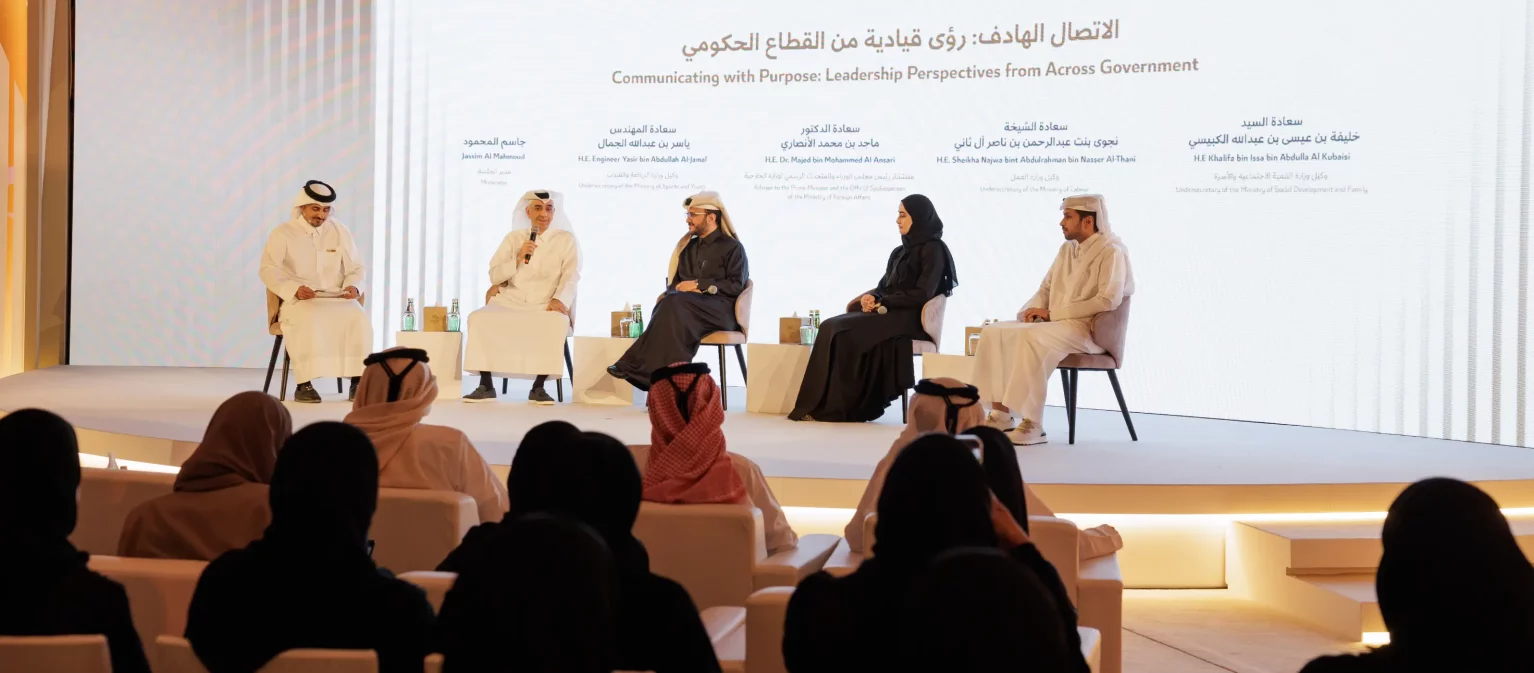
The Government Communications Forum continues dialogue on communication as a tool for influence, trust, and narrative-building in a rapidly evolving local and global landscape, reinforcing the forum’s role as a national platform for leadership dialogue on the role of strategic communications in advancing national priorities and social impact
The second day opened with a panel titled “Communicating with Purpose: Leadership Perspectives from across Government,” featuring HE Eng Yasser bin Abdullah Al Jamal, Undersecretary of the Ministry of Sports and Youth; Dr Majed bin Mohammed Al Ansari, Advisor to the Prime Minister and Official Spokesperson of the Ministry of Foreign Affairs; HE Sheikha Najwa bint Abdulrahman Al Thani, Undersecretary of the Ministry of Labour; and HE Khalifa bin Issa bin Abdullah Al Kubaisi, Undersecretary of the Ministry of Social Development and Family.
The session highlighted leadership’s role in aligning government communications with national priorities, strengthening coordination, and building trust through transparency. It also explored how purpose-driven communication supports long-term institutional readiness and sustained public engagement.
HE Eng Yasser bin Abdullah Al Jamal said strategic communication is central to policymaking, noting that the Ministry of Sports and Youth adopts a participatory approach that engages target audiences from the early stages and measures impact to ensure sustainability and long-term public understanding.
He noted that the Ministry of Sports and Youth launched an implementation program in 2024 to advance Qatar National Youth Policy, including the Qatar Youth Delegates to United Nations Program, which enabled young people to represent Qatar in international forums, with more than 50 graduates to date.
He explained the National Sports Policy includes a dedicated sports communications pillar, recognising sport as a societal value that requires a thoughtful media narrative that highlights athletes’ achievements and advanced national infrastructure.
Dr Majed Al Ansari emphasised that strategic communication has become essential to modern diplomacy, noting that the rapid spread of information means every statement can quickly turn into a headline and shape a country’s international image.
He said the Ministry of Foreign Affairs’ media briefings aim to proactively shape the national narrative, moving beyond reaction to narrative leadership, clearly communicate the state’s positions, and prevent the spread of narratives outside the official context.
He emphasised that media should be viewed as a partner, highlighting the need for trust and respect in media relations and stressed the importance of prioritising local audiences as the foundation of national trust.
HE Sheikha Najwa bint Abdulrahman Al Thani said the diversity of audiences poses the Ministry of Labour’s key communications challenge, requiring multilingual and adaptable messaging without compromising message integrity.
She noted that government communication is now interactive and participatory, with public feedback informing policy development, stressing that trust grows when audiences feel heard and involved in shaping solutions.
She highlighted the importance of unified messaging across government entities, noting that labour market issues require coordinated communication and reaffirming the Government Communications Office’s role as a central reference for official messaging.
HE Khalifa bin Issa bin Abdullah Al Kubaisi emphasised that communication is embedded within the decision-making process, not treated as a later stage. He explained that the Ministry of Social Development and Family’s “From Care to Empowerment” strategy goes beyond messaging, serving as a framework that guides policy choices and initiative design.
He emphasised that addressing sensitive social issues requires a balanced, human-focused approach that upholds dignity and reinforces social inclusion as the foundation of true empowerment. He also highlighted that transparency in discussing social challenges has raised public awareness and supported acceptance of new policies and initiatives, noting that changing social behaviours requires joint communication efforts and wide-ranging media partnerships.
The second day also included a session with HE Saad bin Ali Al Kharji, Chairman of Qatar Tourism, highlighting the role of strategic communications in positioning Qatar as a leading tourism destination, especially after Doha was named GCC Tourism Capital for the year 2026, noting that its selection was the result of a long-term strategy prioritising family tourism, engagement with Gulf audiences, safety, accessibility, cultural identity, and a year-round calendar of events, positioning the country as a leading destination for Gulf families.
He noted that preserving cultural identity is a cornerstone of Qatar’s tourism messaging, highlighting how urban and economic development alongside the preservation of heritage and social values have shaped an authentic tourism experience with global appeal.
HE Saad bin Ali Al Kharji stated that Qatar Tourism plays a key role as the country’s international tourism marketing arm, noting that unified messaging and strategic international media partnerships have strengthened Qatar’s global image and countered misconceptions overseas.
A panel on “Sport and Society: From Fan Engagement to Social Impact” explored how sport can serve as a unifying national narrative and a catalyst for community participation, emphasising strategies to transform fan engagement into lasting social impact.
The second day concluded with a session highlighting the growing role of women in communications leadership, examining their impact on narrative-building, public engagement, and inclusive leadership, as well as their contribution to national priorities and future leadership development in the communications ecosystem.
Source: GCO QATAR


