



Walk through Doha today, and the signs are everywhere, gleaming convention centers, hotel lobbies buzzing with delegates from five continents, and a calendar packed with international summits. In recent years, Qatar has quietly reinvented itself as one of the Middle East’s most dynamic destinations for global events. And behind that transformation is a sector most people outside the industry rarely think about: MICE (Meetings, Incentives, Conferences, and Exhibitions).
It may not carry the glamour of a World Cup final or a Formula 1 race, but the MICE sector is arguably doing more sustained work for Qatar’s economy than any single event ever could. It connects economies, draws international visitors, and pulls investment into the country, and it does so consistently, year after year. In the post-World Cup era, it has become one of the most important pillars of Qatar’s national strategy.
What is MICE and why does it matter?.
At its core, MICE is about bringing people together with purpose. It covers conferences, corporate meetings, exhibitions, and incentive travel programs, gatherings that pull in business leaders, investors, policymakers, researchers, and innovators from every corner of the globe. The goal isn’t just networking; it’s deal-making, knowledge exchange, and building the kinds of relationships that shape industries.
Qatar has actively positioned itself as a regional hub for such events. With advanced venues, strong aviation connectivity, and a reputation for hosting global gatherings, the country has steadily expanded its presence in the international events market.
According to industry statistics, Qatar hosted more than 1,250 business events in 2023, a 22% increase from the previous year. These events collectively contributed to a market size of approximately QAR 18.4 billion for the events industry. That kind of growth doesn’t happen by accident; it reflects years of deliberate investment and strategic positioning.
The Numbers Behind the Boom.
It’s easy to think of a conference as just a gathering of people in a room. But each event sets off a chain reaction across the broader economy, filling hotel rooms, booking flights, feeding restaurants, moving freight, and generating media coverage. The economic footprint of a single major summit can stretch across dozens of industries.
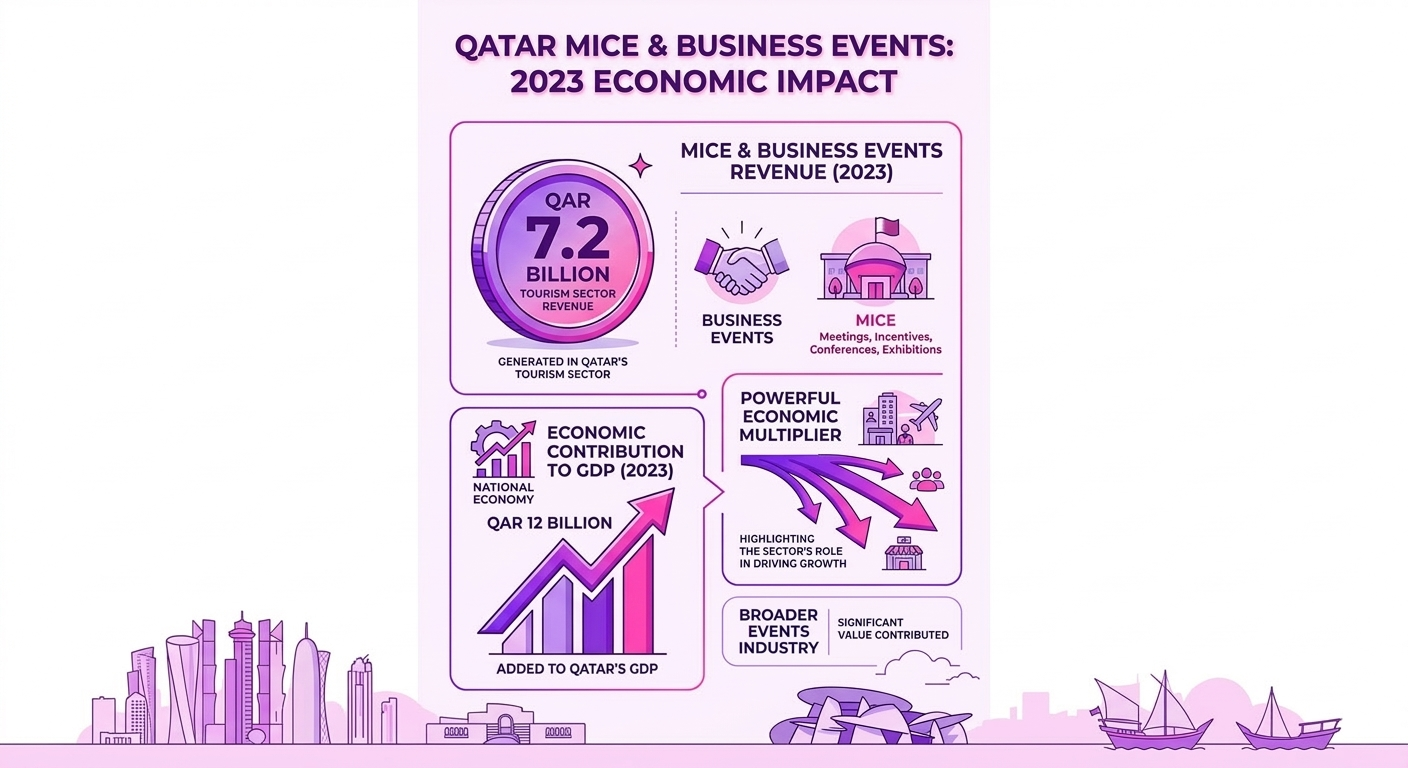
In 2023 alone, MICE and business events generated approximately QAR 7.2 billion in revenue within Qatar’s tourism sector. Additionally, the broader events industry contributed significant value to the national economy. Statistics indicate that MICE events added around QAR 12 billion to Qatar’s GDP in 2023, highlighting the sector’s role as a powerful economic multiplier.
Economists call this the multiplier effect, and it’s particularly pronounced in the events sector. Every riyal spent on a conference registration or exhibition booth flows outward, into catering contracts, hotel bookings, transport services, and supplier payments, amplifying the value of each event well beyond its face cost.
This is precisely the kind of growth Qatar National Vision 2030 is designed to encourage. The long-term plan calls for moving the economy beyond its dependence on hydrocarbons, and sectors like MICE, with their ability to generate revenue, jobs, and global connections simultaneously, are exactly what that transition looks like in practice.
A Tourism Engine in Its Own Right.
Qatar’s tourism sector has been on a remarkable upward trajectory, and business travel has been one of its most consistent drivers.

The events industry supported approximately 150,000 jobs in Qatar in 2023, including roles in event planning, hospitality, logistics, media, marketing, and technical services. Tourism also plays a major role in employment, with around 70,000 direct tourism jobs recorded in 2023.
A substantial share of this growth is driven by business travel and event participation. In fact, business tourism spending reached QAR 8.5 billion in 2023, demonstrating how conferences and exhibitions directly translate into visitor expenditure. Business travelers are, on average, higher spenders than leisure tourists. They stay in premium hotels, eat at better restaurants, and rarely think twice about transport costs. The average international visitor to Qatar spends around QAR 5,200 per trip, and business visitors tend to push that figure even higher.
And the relationship doesn’t always end when the conference does. Many delegates extend their stay to explore the country, and a good number return later with family, turning a business trip into the beginning of a longer-term connection with Qatar.
Built for the World: Qatar’s Infrastructure Advantage.
None of this would be possible without the physical foundation Qatar has spent years building. Over the past decade, billions of dollars have been invested in tourism and event infrastructure, including convention centers, exhibition venues, hotels, and transportation networks. Investment in tourism infrastructure alone is expected to exceed $45 billion under Qatar’s long-term development strategy.
Flagship venues such as the Qatar National Convention Centre and the Doha Exhibition and Convention Center have enabled the country to host large-scale global events. These venues can accommodate thousands of delegates and exhibitors at once, giving Doha the capacity to host everything from global technology summits and financial forums to cultural festivals and industry expos, events that once would have defaulted to Geneva, Singapore, or Dubai.
The Local Businesses Powering Every Event.
The headlines go to the international speakers and the global brands. But behind every major event is a network of local businesses making it all happen.
Small and medium enterprises (SMEs) form the backbone of Qatar’s event supply chain. In fact, around 80% of companies involved in event services are SMEs, including event management firms. Every major event is, in effect, a procurement exercise for the local economy, commissioning work from production companies, photographers, transport providers, florists, digital agencies, and dozens of other small operators who rarely make the press release but are essential to the final product. from production companies and photographers to transportation providers and digital marketing agencies.
Exhibitions and trade fairs also create platforms for local businesses to showcase their products, meet investors, and expand into global markets. In this way, MICE doesn’t just bring the world to Qatar; it pulls Qatar’s own businesses into the world.
People, Skills, and the Jobs Behind the Scenes.
The jobs created by Qatar’s events sector are often invisible to the casual observer, but they’re substantial.
The events industry supported approximately 150,000 jobs in Qatar in 2023, including roles in event planning, hospitality, logistics, media, marketing, and technical services. Tourism also plays a major role in employment, with around 70,000 direct tourism jobs recorded in 2023.
As the events ecosystem expands, it encourages workforce development in fields such as event management, hospitality leadership, digital media, and conference technology. These skills are increasingly important in building a diversified, knowledge-based economy.
Putting Qatar on the World’s Map, Permanently.
The impact of MICE isn’t only measured in riyals. It’s also measured in how the world perceives Qatar.
When a major climate summit or a global fintech conference chooses Doha as its host city, it signals that Qatar is a place where serious conversations happen, decisions are made, and the world’s sharpest minds gather. Events also reinforce Qatar’s reputation as a safe, modern, and business-friendly destination.
Following the global success of the 2022 FIFA World Cup, the country has leveraged its infrastructure and international recognition to attract new global gatherings in sectors such as technology, finance, sports, sustainability, and education.
It’s a smart play: turning the infrastructure and goodwill of a single mega-event into a permanent platform for ongoing global engagement.
What Comes Next.
The future of Qatar’s MICE industry appears highly promising. Market forecasts suggest the country’s events sector could grow as global business travel continues to recover. Qatar is well placed to capture a meaningful share of that demand, not just as a regional player, but as a genuinely global destination. As global business travel continues to recover and expand, Qatar is well-positioned to capture a growing share of the international MICE market.
With strong airline connectivity, modern venues, luxury hospitality, and strategic government support, the country has established the foundations of a thriving events ecosystem.
The MICE industry is far more than a calendar of conferences and exhibitions. In Qatar, it has become a quiet but powerful force, one that stimulates tourism, sustains small businesses, creates tens of thousands of jobs, and steadily builds the country’s standing on the world stage.
What Qatar is demonstrating to the region and to the world is that events are not just occasions. They are instruments of economic transformation. The country’s journey toward a diversified, knowledge-based economy is still unfolding. But if the last few years are any indication, the MICE sector won’t just be along for the ride; it will be leading the way.