





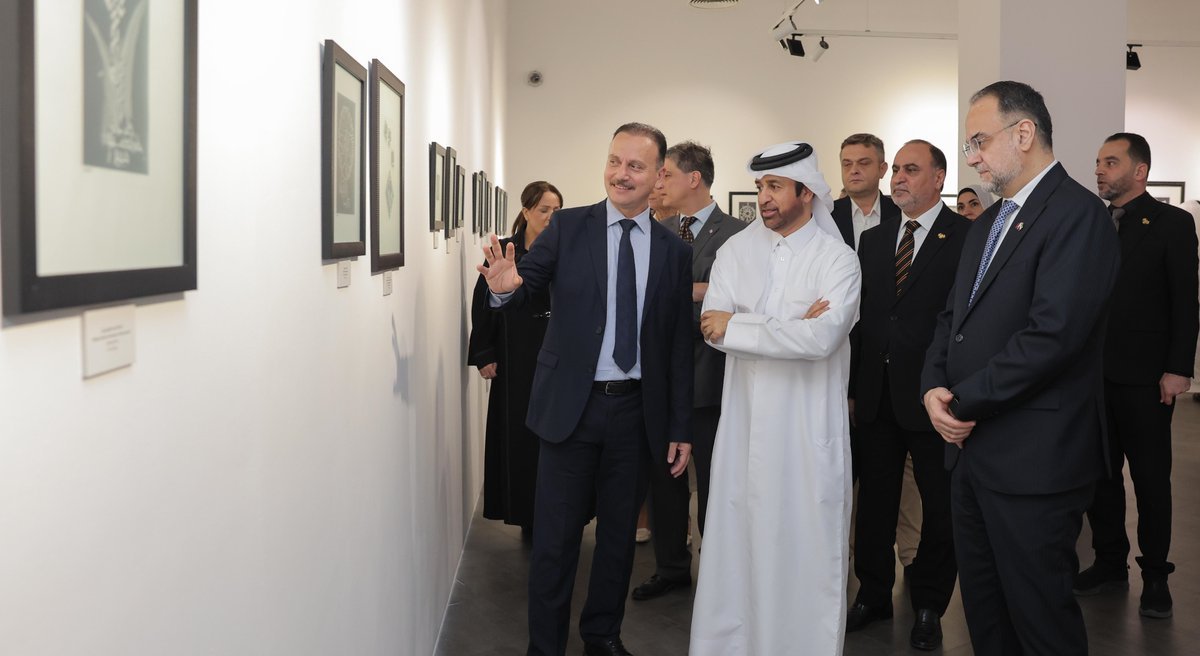
Doha: The Katara Cultural Village on Monday inaugurated the “Qabasat” Exhibition by Syrian artist Dr. Wassim Al Hamdou, featuring a unique collection of artworks that merge the timeless beauty of Arabic calligraphy with contemporary artistic expression.
The opening ceremony was attended by Katara Director-General Dr. Khalid Ibrahim Al Sulaiti, as well as Dr. Bilal Turkia, Charge d’Affaires at the Embassy of the Syrian Arab Republic to the State of Qatar, alongside ministers, diplomats, cultural figures and art enthusiasts.


Running until June 29, the exhibition offers visitors an immersive artistic experience through works inspired by the masterpieces of Arabic calligraphy and the rich legacy of Arab and Islamic civilization. The collection reflects an artistic vision that harmonizes authenticity and innovation, presenting heritage through a contemporary lens.
Speaking at the inauguration, Dr. Bilal Turkia said the artworks embody the values of beauty, knowledge and identity that define Arab and Islamic culture. He praised Al Hamdou’s ability to unite the authenticity of Arabic calligraphy with the spirit of modern art, creating works that convey profound cultural and human messages through innovative techniques.
He added that the exhibition carries particular significance as a distinguished presentation of Syrian art and culture in Qatar during an important period in Syria’s history. The event, he noted, highlights the strength of the brotherly ties between Qatar and Syria and reflects growing cultural cooperation that contributes to enhancing mutual understanding and people-to-people connections.
For his part, Dr. Al Hamdou described the exhibition as an important milestone in his artistic journey, which has included exhibitions across several Arab countries. He said hosting “Qabasat” at Katara holds special importance given the institution’s standing as one of the region’s leading cultural and artistic landmarks and its role in promoting creativity and intercultural dialogue.
Al Hamdou explained that his works present Arabic calligraphy through a distinctive personal style rooted in his longstanding passion for the art form. Most of the pieces were created using ink-based techniques and mixed-media methods, with selected works incorporating acrylic paints to add texture, visual depth and experimental dimensions to the artistic compositions.
The exhibition invites visitors to explore a contemporary interpretation of Arabic calligraphy while celebrating the enduring cultural heritage of the Arab and Islamic worlds.
Source: QNA


