





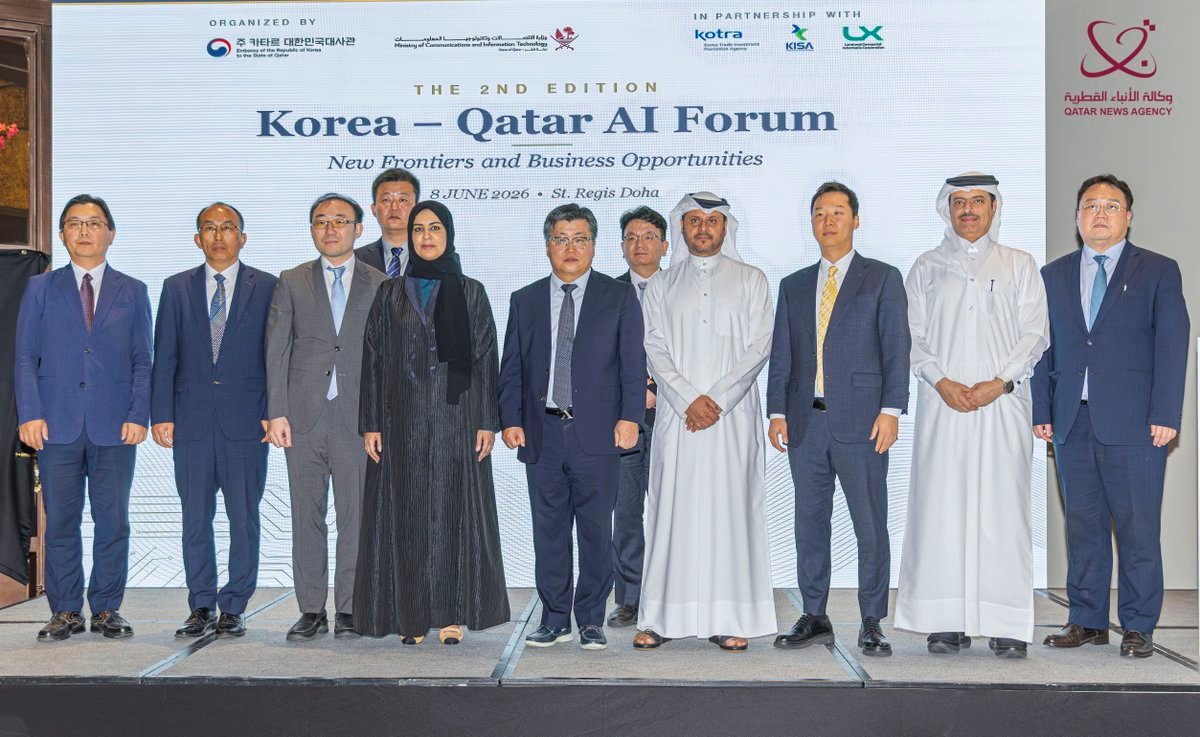
Doha: The second Qatar-Korea Artificial Intelligence Forum opened in Doha on Monday under the theme “New Horizons and Business Opportunities,” bringing together government officials, industry leaders, and technology experts to explore the future of artificial intelligence and deepen bilateral cooperation in digital innovation.
The forum is organized by the Ministry of Communications and Information Technology (MCIT) in partnership with the Embassy of the Republic of Korea in Doha and the Korea Trade-Investment Promotion Agency (KOTRA).
Speaking at the opening session, Reem Mohammed Al Mansoori, Assistant Undersecretary for Digital Industry Affairs at MCIT, described the forum as a key platform for advancing cooperation between Qatar and the Republic of Korea and translating dialogue into practical initiatives with measurable impact.
She said artificial intelligence has become a critical driver of global competitiveness and emphasized that Qatar has positioned AI at the center of its digital transformation agenda in line with Qatar National Vision 2030 and the Digital Agenda 2030.
Al Mansoori noted that Qatar aims to contribute to building a regional digital ecosystem founded on trust, innovation, and high-value partnerships. She also highlighted the country’s achievements in digital infrastructure, including its ranking as the world’s leading nation for secure infrastructure in the 2025 Innovation Index and its position as the second-fastest country globally for mobile internet speed.
She further pointed to international recognition of Qatar’s Digital Agenda 2030, which has been cited by the United Nations as a model of best practice in digital transformation.
For his part, Sami Mohammed Al Shammari, Assistant Undersecretary for Infrastructure and Operations Affairs at MCIT, said digital infrastructure, artificial intelligence, and digital sovereignty form the foundation of the next phase of Qatar’s digital transformation journey.
He stressed that Qatar has moved into a stage focused on converting national digital strategies into practical and measurable outcomes, supported by significant progress in digital infrastructure, cybersecurity, data governance, and government services.
Al Shammari revealed that MCIT is working to enhance AI readiness across government entities and plans to develop more than 50 AI use cases within the public sector by 2029 to improve service delivery and operational efficiency.
He noted that AI applications are already generating tangible benefits through automation, process optimization, and improved performance, adding that successful AI adoption requires not only advanced technology but also institutional readiness, public trust, and robust governance frameworks.
Highlighting the growing partnership between Qatar and the Republic of Korea, Al Shammari described the relationship as a model for international cooperation in artificial intelligence. He noted that South Korea brings extensive expertise in semiconductors, digital platforms, and cybersecurity, while Qatar offers a clear strategic vision and substantial investments in digital infrastructure.
He added that bilateral collaboration currently spans several strategic sectors, including AI infrastructure, smart government services, cloud computing, and smart mobility solutions, paving the way for expanded innovation and business opportunities between the two countries.


